Why Is an Ostomy Performed?
A number of conditions call for an ostomy as part of the treatment and recovery. These include cancer of the colon and rectum, trauma, malformations present from birth, obstruction of the bowel, complications of diverticulosis, and Crohn's disease. In each of these, an ostomy may be the best and safest form of treatment. In certain conditions the ostomy may be temporary and can be reversed at a later date. In the past, surgery for ulcerative colitis required a colostomy. Now, a rectal pouch can usually be created out of the small intestine. Liquid stool is then passed through the rectum 3-6 times a day.
The Psychology of an Ostomy
When the physician first mentions an ostomy, every patient, without exception, has negative feelings. The younger the patient, the harder it is to accept an ostomy. There is probably no surgical procedure that produces more misunderstanding and fear than an ostomy.
After the surgery, the patient needs time to heal, to learn how to manage the ostomy, and to mentally adapt to these changes. In time, the patient usually finds that life is only slightly altered, if at all. Most would rather have the ostomy than their previous medical conditions.





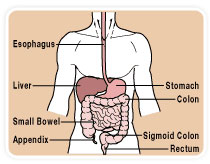
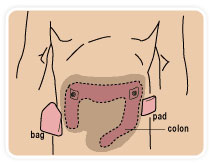 An ileostomy involves bringing the ileum (the last portion of the small intestine) to the abdominal surface. When waste matter reaches the ileum it is liquid, so an appliance is needed to collect it. However, a type of ileostomy called a Koch's pouch or continent ileostomy does not require an appliance. The physician and surgeon discuss these choices with the patient.